
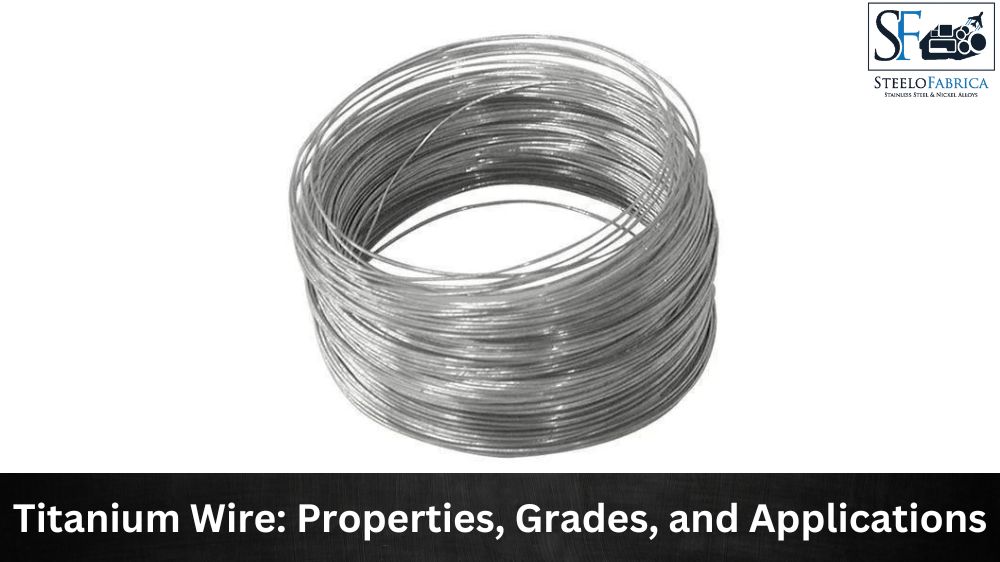
Titanium is a fascinating and highly sought-after material known for its incredible strength, lightweight, and corrosion resistance. Among the many forms of titanium available, titanium wire is especially versatile and useful, finding applications in various industries, from aerospace to biomedical. This blog post will explore the properties of titanium wire, the different available grades, and the applications where people commonly use it.
Titanium wire is a high-strength, low-density metal wire available in a range of diameters, typically from 0.1mm to 10mm. The properties of titanium wire make it an attractive material for many applications, as it is incredibly strong, corrosion-resistant, biocompatible, and non-magnetic. Furthermore, Due to its low modulus of elasticity, it can be deformed with less force than other metals, making it an ideal material for forming into various shapes.
Properties of Titanium Wire
Titanium wire has unique properties, making it a great choice for commercial and industrial use. It is extremely lightweight, strong, corrosion-resistant and non-toxic. The lightweight nature of titanium wire (4 times stronger than aluminum yet 45% lighter) makes it ideal for applications where weight needs to be minimized, such as aircraft electrical systems or medical implants. Its strength also allows fine wires to support higher tension without sagging or breaking, making them perfect for lifting heavy loads.
In addition, titanium wire is non-magnetic and has a good tensile strength, which can withstand high temperatures without melting or burning out quickly as other metals do. Regarding corrosion resistance, titanium has an excellent reputation for withstanding harsh outdoor conditions due to its passivation layer, which forms on the metal surface when exposed to air and helps repel acidic environmental elements that would otherwise corrode most other metals. Lastly, titanium is non-toxic and biocompatible with human tissue, so it can safely be implanted into the body without irritating. This makes it a popular choice in medical applications where delicate wires need maximum precision while being safe around patients’ fragile organs.
Grades of Titanium Wire
Due to its physical strength and corrosion-resistance properties, industries in the medical, aerospace, and industrial sectors widely use titanium wire. There are various grades of titanium, and they can be categorized based on their primary composition, such as Grade 1 (unalloyed titanium) or Grade 4 (“CP Ti”).
Grade 1:
Unalloyed titanium provides excellent cold working characteristics, high biocompatibility for medical implants, and superior weldability. It has an ultimate tensile strength of 100–200 MPa and an elongation rate of up to 15%.
Grade 2:
Commercially pure grade 2 titanium offers improved ductility over unalloyed grades with a corresponding decrease in strength. It also exhibits enhanced crack propagation behaviour when compared with other alloys. Its modulus of elasticity ranges from 110–140 GPa, while its ultimate tensile strength ranges from 345 MPa up to 450 MPa.
Grade 3:
This alloy combines elements such as vanadium and aluminium into commercially pure titanium, increasing yield strength and hardness values while maintaining excellent formability properties. Its ultimate tensile strength is greater than 895MPa, while its modulus of elasticity remains between 105-135 GPa depending on tempering temperature conditions used during processing.
Grade 4:
Manufacturers specifically design Grade 4 titanium wire, also known as “CP Ti,” for biomedical applications where it must consistently offer resistance against harsh environments, such as body fluids. It comes with very high levels of corrosion resistance combined with extremely good formability properties allowing it to retain shape even when exposed to extreme stress applications without exhibiting any signs of fatigue or deformation over periods found within normal medical usage scenarios. Titanium exists in various grades, and they categorize them based on their primary composition, such as Grade 1 (unalloyed titanium) or Grade 4 (“CP Ti”).
Applications of Titanium Wire
Various applications, including medical implants, braces, aerospace components, automotive parts, decorative objects, and sporting goods, use titanium wires. Some of the most common applications include medical implants such as pins, plates and screws; industrial and architectural applications including wire rope, cables/wires for electrical conduits; sporting goods like fishing rods; consumer products such as eyeglasses frames; aircraft components for both military and commercial aviation industries; automobile exhaust systems etc.
Conclusion:
Its strength, lightweight, and versatility make titanium wire a remarkable material highly valued. With its excellent corrosion resistance, biocompatibility, and non-magnetic properties, titanium wire is ideal for various aerospace, medical, sporting, and construction applications. Understanding the different grades of titanium wire and their specific properties is essential for selecting the right material for a specific application. As innovative technologies emerge, titanium wire will likely continue to grow in popularity across multiple industries.